Blind Tigers & Monkey Rum
- Charles Thrasher
- Oct 9, 2025
- 9 min read

In 1908, North Carolina was the first Southern state to pass statewide prohibition, 62% to 38%, after having been the first Southern state to fail the attempt in 1881. The law made it illegal to manufacture, transport, or sell alcohol in the state. It didn’t make it illegal to buy it.
There is probably no other law in North Carolina’s history that has been more often broken by its citizens and ignored by its police. It was broken by both wealthy and poor, white and Black, but the poor were more likely to be prosecuted.
Typical of previous attempts at prohibition, both the price and the demand for illegal liquor skyrocketed.
“Whenever a substance is banned, two things happen. First, the price goes up, and second, the product returns in a more concentrated form, or a replacement appears.” [1]
In the case of prohibition, it returned as corn liquor and monkey rum.
Blind Tigers
Once prohibition became national, Illegal bars were generally known as a “speakeasy” but in North Carolina, the older term “blind tiger” was more common.
Blind tigers were typically physical locations, in the basement or behind false walls in bakeries and grocery stores, but the term was extended to the operators and even “walking blind tigers,” people selling illegal liquor on the street.
Monkey Rum
Liquor was mostly made in stills secreted in the countryside, then brought into Washington.
Monkey rum was cheaper to make than corn liquor, requiring only molasses and water. The strong smell of molasses was a sure clue to the presence of a still. The end product was nearly 100% proof. There was so much alcohol in it that a match set to a saucerful would burn a full five minutes. It also produced a hallucinogenic drunk. [2]
Illegal liquor was typically distilled in the countryside, then brought into Washington to sell or drink privately.
For several years prior to 1916, Chocowinity had been notorious for its blind tigers and stills. [3]
The Rev. J.M. McKenzie, pastor of the Chocowinity Baptist Church and an active campaigner for the enforcement of prohibition, had his life repeatedly threatened by bootleggers and blind tigers. [4]
Even in 1917, Judge George H. Brown complained to the Beaufort County Board of Commissioners that a blind tiger was operating openly at the foot of the county bridge on the south shore. [5]
Dick Johnson was discovered with a 61 gallon still, 20 gallons of monkey rum, and two gallons of rye whiskey hidden in a pit on his property near Beaver Dam. His neighbors complained there was always a crowd of drunks around his place on Sundays.
Ten to fifteen horses and buggies visiting one place every Sunday near Haw Branch was also suspicious, especially with the distinct smell of molasses drifting on the breeze.
Sympathy for the Devil
In 1910, the Washington Daily News wondered in print why Washington’s police officers would travel to the “remotest part of the city to raid a [crap] game between a few negroes where there is usually from 25 to 50 cents at stake and then allow blind tigers to run openly day and night almost under their nose.”
“Within a radius of 250 yards from the city hall there are a number of speakeasies dealing out whiskey in any quantity,” the paper claimed.[6]
Even when someone was arrested and charged, there were rarely convictions.
In 1913, the Daily Times lamented: “The majority of our people—even those who rank very high socially, smile and joke about the blind tiger. The crime of illegally disposing of liquor is not considered a serious one. When a man is brought to court the sympathy is with the accused—and not the accusers. Taking these facts into consideration, is it any wonder that no check is put on the blind tigers?” [7]
Fenner Deal was arrested in Aurora, accused of selling illegal liquor. Hiding in the bushes, witnesses saw Deal sell liquor to eleven different men. They even purchased some from Deal themselves. There was a jury trial. The jury deliberated briefly and acquitted the defendant. [8]
There was such popular sentiment against convicting blind tigers that the acting prosecutor in Fayetteville allegedly refused to prosecute further cases. It was evident to him that Fayetteville wanted blind tigers. As far as he was concerned, it could have them. [9]
The jury didn’t especially value the word of a man who would deceive another to entrap him.
Under Cover
In 1913, the Beaufort County Board of Commissioners secretly decided to hire detectives from a Raleigh detective agency at $5 per day. [10] The detectives’ purpose was to infiltrate blind tigers under cover, solicit the sale of liquor, and provide evidence of the crime of “retailing” at trial. It rarely worked that way.
In May 1915, the courtroom of Assistant Recorder Bryan was crowded with spectators and friends of the accused. The case was the State vs. William Bridgers, an alleged blind tiger. Detective Davis was the state’s principal witness. Colonel Wiley Croom Rodman defended Bridgers. In 15 minutes of deliberation, the jury rendered a verdict of not guilty. [11]
It was a case of Detective Davis’s word against William Bridger’s, and the jury didn’t especially value the word of a man who would deceive another to entrap him.
Public sentiment was with the law breakers, according to the Daily News. [12]
125 prohibition officers have given their lives in vain...
A Dubious Distinction
By 1921, even the Internal Revenue Commissioners despaired of containing the traffic in illegal booze. “All the efforts of county, state and federal prohibition officers in Eastern North Carolina,” one Commissioner claimed, “have proved futile in checking the quantity of liquor made in this section.” [13]
Federal Revenue agents confiscated 6,000,000 gallons of alcoholic beverages in 1921; 40,000 people were arrested for liquor violations. North Carolina led the nation in both the number of distillers and stills seized. Virginia was second.
The New Bern Sun-Journal claimed 125 prohibition enforcement officers had been killed by bootleggers since Prohibition had begun, but fewer than 50 bootleggers had been killed.
“…It almost seems as though the 125 prohibition officers have given their lives in vain, for instead of curtailing violations against the laws the last year or so appears to have seen an increase. There are more persons engaged in the illicit manufacture of liquor today than there have been at any time since the prohibition laws went into effect. And the number is steadily increasing.” [14]
Even the patience of religious teetotalers had frayed.
“The only good bootlegger is a dead bootleggers” was the title of an article published in the World Digest of the Reform News issued by the Methodist Board of Temperance. The article discussed an incident where revenue agents stopped suspected bootleggers.
“Both bootleggers leaped from the car with drawn revolvers; nevertheless, the officers took them alive.”
The Methodist Board of Temperance thought it was an unwise policy. “…a bootlegger is worth a lot more to the country dead than alive.” [15]
Smugglers’ Blues
Bootleggers were clever. They shipped liquor from Virginia, still a non-prohibition state until 1916, in barrels marked “herring roe.” The roe was layered on top and bottom but between were stacked fifty pints of whiskey to the barrel. They shipped in crates marked “crockery” and “wearing apparel” on the Coast Line Railroad.[16] In Winston-Salem, they carried a casket into the Eagles’ Club filled with ten gallons of corn liquor.[17]
Whiskey was sometimes carried up the Pamlico River by boat, likely from the stills on Milltail Creek, what is now the Alligator River National Wildlife Refuge, but then one of the most prolific producers of illegal whiskey in the country. In 1920, 12 gallons of corn liquor was confiscated from a sloop anchored in the Pamlico River opposite the Moss Planing Mill. [18]

The Klan Revived
North Carolina’s enforcement of prohibition laws was woefully underfunded. The same was true of Federal enforcement when the 18th Amendment was ratified. Lack of funding and the indifference of both police and prosecutors resulted in the resurrection of the Ku Klux Klan.
The Klan was first founded as a white supremacist terrorist organization during Reconstruction (1865-1877). Its primary objectives were political suppression, economic intimidation, and opposition to federal authority. It became less relevant with the end of Reconstruction.
The Klan was revived in 1915, reaching a peak membership of several million in the 1920s. It was more populist in its hate, targeting Catholics, Jews, and immigrants as well as Blacks.
The revived Klan positioned itself as the enforcer of prohibition when the law was not enough. In Craven County, the Klan announced its intentions.
“The Klan feels that a condition, not a theory, confronts the law-abiding people of this community, and that at once notice should be served on all bootleggers both white and black that their traffic in liquor must and will end. If it is not, the processes of the law will be invoked without regard to who is hurt.”
The “immunity of a bootlegger apparently free from the due operation of the law” would not be tolerated. [19]
“If local officials cannot enforce the law,” vowed one Klan leader and Methodist minister in Denver, Colorado, “we should teach them how.” The Indiana Klan’s magazine, the Fiery Cross, promised, “The Klan is going to drive bootlegging out of this land.” In Williamson County, Illinois, the federal Prohibition Bureau agent in charge deputized hundreds of Klansmen from neighboring counties to assist in a series of simultaneous raids. The resulting deadly mayhem led higher-ups in the Prohibition Bureau to replace the head agent. [20]
The Chemist’s War
In a desperate attempt to reverse the failure of prohibition, the federal government began poisoning “denatured” alcohol, making it unpalatable. By the mid-1920s, bootleggers had figured out how to “renature” the stuff and were stealing 60 million gallons of denatured alcohol each year.
Bootleggers had no intention of killing their customers; that was the intention of the federal government. The government ordered legitimate distillers of denatured alcohol to include mercury salts, benzene, cadmium, zinc, ether, chloroform, carbolic acid, acetone, iodine, formaldehyde, kerosene, even gasoline, in order to counter the bootleggers. The government policy was known as the “chemist’s war” and resulted in thousands of deaths. Other symptoms included hallucinations, uncontrollable vomiting, even blindness.
Charles Norris, the New York medical examiner, held a press conference to warn of the danger. “The government knows it is not stopping drinking by putting poison in alcohol. Yet it continues its poisoning process, heedless of the fact that people determined to drink are daily absorbing that poison. Knowing this to be true, the United States government must be charged with the moral responsibility for the death that poisoned liquor causes, although it cannot be held legally responsible.” [21]
Wayne Wheeler of the Anti-Saloon League supported the government’s poisoning of denatured alcohol. “The Government is under no obligation to furnish the people with alcohol that is drinkable when the Constitution prohibits it. The person who drinks this industrial alcohol is a deliberate suicide. To root out a bad habit costs many lives and long years of effort.’ [22]
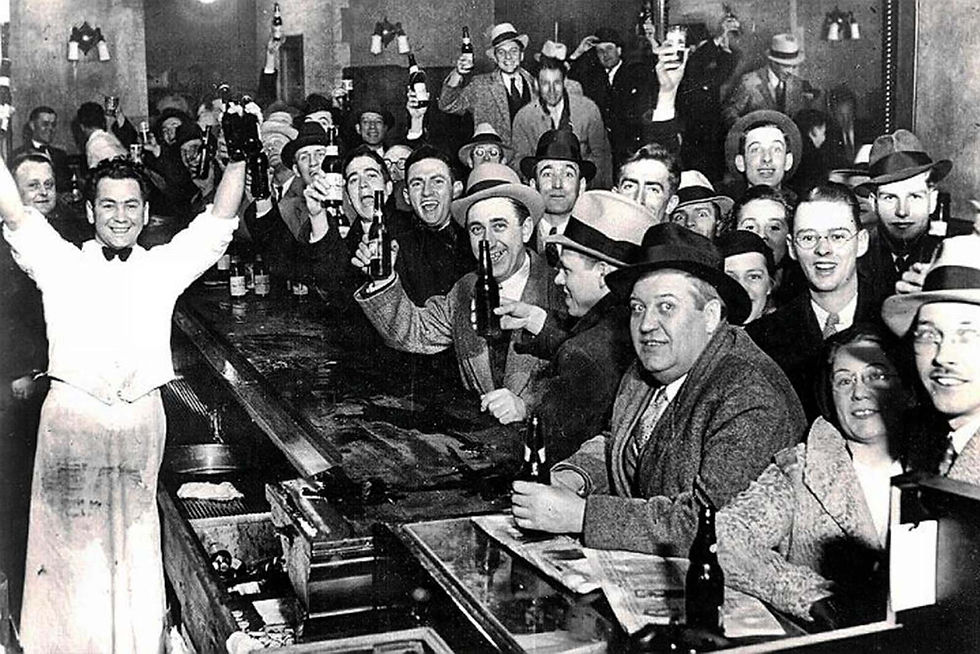
End of Prohibition
National prohibition was ended by ratification of the 21st Amendment in 1933. It was the only time in our history when one amendment was repealed by another.
The country had enough of the “Noble Experiment.”
Pointedly, North Carolina failed to ratify the 21st Amendment. The state had prohibition 10 years before the 21st Amendment and five years after. In 1937, the first legal liquor sales in North Carolina occurred since 1908.
Prohibition in North Carolina was a failure but it was a popular failure. Newspaper columnist Franklin Adams expressed the sentiment.
Prohibition is an awful flop. We like it.
It can’t stop what it’s meant to stop. We like it.
It’s left a trail of graft and slime, It don’t prohibit worth a dime,
It’s filled our land with vice and crime.
Neverthelesss, we’re for it.
See also Ballot in One Hand, Bottle in the Other and Whiskey Culture for more information on Washington, NC and Prohibition.
Notes
[1] Rorabaugh, W.J., Prohibition: A Concise History
[2] Washington Daily News, September 9, 1915: 1
[3] Washington Daily News, August 16, 1916: 3
[4] Washington Daily News, ibid
[5] Washington Daily News, August 8, 1917: 3
[6] Washington Daily News, March 23, 1910: 1
[7] Washington Daily News, May 21, 1913: 2
[8] Washington Daily News, July 6, 1915: 1
[9] Washington Daily News, November 18, 1915
[10] Washington Daily News, October 30, 1913: 1
[11] Washington Daily News, May 27, 1915: 1
[12] Washington Daily News, May 29, 1915: 1
[13] New Bernian, September 20, 1921
[14] New Bern Sun-Journal, October 11, 1922
[15] New Bernian, November 2, 1921
[16] Washington Daily News, May 27, 1915
[17] Washington Daily News, July 16, 1915: 1
[18] Washington Daily News, June 30, 1920: 1
[19] New Bernian, November 22, 1924
[20] Rorabaugh, W.J., ibid
[21] The Chemist’s War, Slate Magazine
[22] National Affairs, Time Magazine, January 10, 1927


Comments