Timber Town: Washington & the Lumber Trade
- Charles Thrasher
- Nov 7, 2025
- 8 min read
Since the Civil War, the strident whine of massive saws and the smell of sawdust dominated Washington’s waterfront. Steam whistles echoed between the riverbanks as tugs towed rafts of logs to the mills or hauled barges with milled lumber from the wharves. The mill whistles kept cadence with the workday. Men shouted to each other as they balanced on floating logs, herding them toward the steam hoist that would drag them into the mill. It was a loud, bustling, boisterous waterfront and a dangerous one.
From its founding, milled lumber was one of Washington’s primary products. Tannyhill and Lavendar built Washington’s first sawmill in 1831, then built a steam tug, the Edmund McNair, to tow logs to the mill. [1] Throughout the next century, most of the steam tugs built in Washington’s shipyards were for the lumber business. [2]
Logging was a hazardous business from the start. Loggers felled trees in the forest with double-handed whip saws—a long, straight blade with handles at either end. It was a laborious effort, alternately pushing and pulling, to bring down a big tree. Barber pole trees that had grown with a spiral grain were especially dangerous, whipping about in unexpected directions as they fell. Once felled, loggers would often use teams of oxen, or mules and horses less often, to drag the logs to the water’s edge. If descending a hillside, the logs sometimes gained momentum, overtaking and crippling or killing both men and animals.
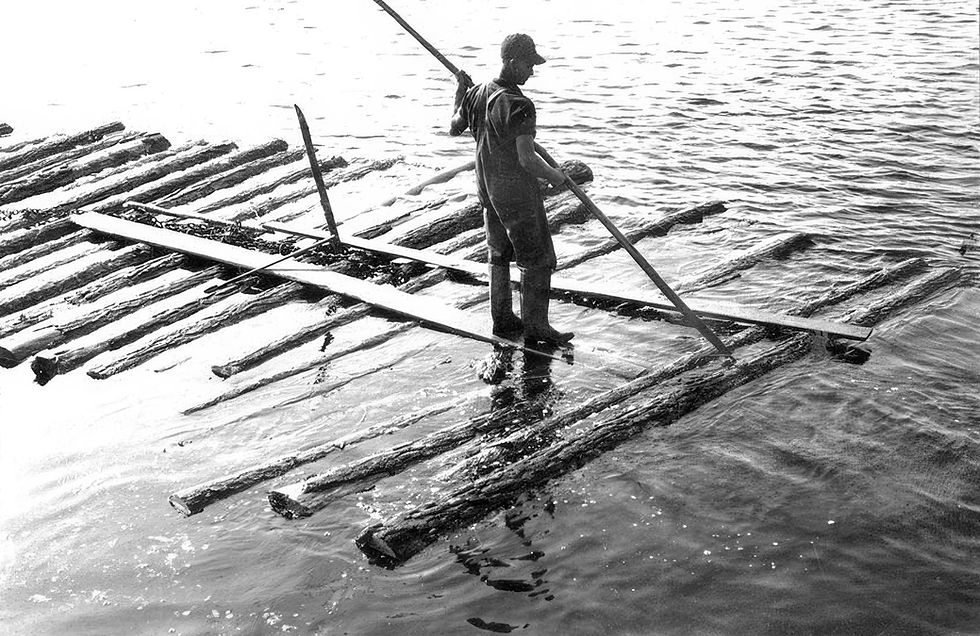
Once in the water, men would balance themselves precariously on the floating, rolling logs, chaining them together. Sometimes the rafts would contain several hundred large logs. [3] Falling between the logs, men were crushed, maimed, and drowned.
Surrounded by piles of sawdust and slabs of discarded lumber and stacks of cut boards drying in kilns, a sawmill was a fire waiting for a match.
Steam tugs would then haul the rafts downriver. Large rafts were difficult to manage and a hazard to other vessels navigating the river. At the Washington mill site, the logs were impounded in what was essentially an artificial pond formed on the banks of the river.
The log pound stored the logs until needed by the mill. It also kept them from drying and cracking or catching fire. With mountains of sawdust and the discarded remnants of saw cuts, fire was a fearful hazard at every sawmill.
Fear of Fire
Before dawn on January 9, 1890, the steam whistle of the Kugler Lumber Company’s mill at the foot of Harvey Street sounded the alarm, followed by the fire bell. The fire department and a large group of citizens gathered to fight the fire. They knew from experience that a fire started on Water Street could spread to the entire town.
The mill was too engulfed in flames to save. The steamer Beaufort on the ways at Farrow’s shipyard and the residences across the street were in imminent danger but were saved. [4] The sawmill, dry kilns, and a considerable amount of lumber were burned. The cause was attributed to spontaneous combustion. [5]
The people of Washington had a rightful fear of fire. Ten years after the fire at the Kugler sawmill, most of Water Street and much of Market Street burned to the ground. (See A Surging Holocaust for more information.)
Surrounded by piles of sawdust and slabs of discarded lumber and stacks of cut boards drying in kilns, a sawmill was a fire waiting for a match.
“He was holding to a post and leaning over, when the fly wheel struck and cut the whole top of his head off. His grip on the post was so firm that it was with difficulty he was released.”
Power of Steam
Steam powered the industrial revolution following the Civil War. A sawmill converted wood into motion through steam, which then drove all the saws, conveyors, and planers in the mill.
The boiler was fired with wood waste from the mill—discarded slab ends, bark, or sawdust. Water was fed into the boiler by hand or a steam-powered feed pump. Once pressure reached about 80-120 psi, steam was piped to the engine.
The stationary steam engine converted steam pressure into rotary motion. The engine’s piston moved back and forth inside a cylinder. That motion turned a crankshaft and flywheel, creating smooth, continuous rotation. The engine’s governor regulated speed by adjusting steam intake.
Power was mechanically distributed from the engine’s flywheel throughout the mill. A main drive belt ran to a line shaft—a long rotating shaft running the length of the building. Each machine (saws, planers, edgers) had a pulley and flat belt that could be engaged or disengaged from the line shaft by the operator.
There were plenty of opportunities for personal injury.

Hazardous Duty
A sawmill was a dangerous place to work. The noise of massive saws, reciprocating or circular, was deafening. Workers used hand signals or whistles to communicate with each other. Chronic exposure could damage workers’ hearing.
More immediate dangers were the saws, pulleys and belts themselves.
In 1877, while Nathan Hicks was working at Kugler’s sawmill, a nut came off the belt driving the trimmer (a saw that trimmed the rough-cut boards into even lengths). While trying to secure the nut, the belt came off the drum and wrapped him around the shaft three or four times. The shaft was only 15 inches above the floor. He died the next morning. [6]
In 1888, Thomas Hadder was killed instantly at Kugler’s sawmill in Pamlico County. “He was holding to a post and leaning over, when the flywheel struck and cut the whole top of his head off. His grip on the post was so firm that it was with difficulty he was released.” [7]
While most people in Washington were having breakfast or starting their workday, an explosion shook every building in town, shattered windows and knocked plaster from ceilings.
In 1889, in Glen Alpine, the Washington Progress reported that a 14-year-old boy working at a sawmill was caught by a belt and thrown several feet, breaking his leg in two places, tearing off his arm, and mangling his body. He lived for about 48 hours. [8]
In 1892, at Sink’s sawmill in Wilkes County, Thomas Watkins was under the saw cleaning out the dust. On raising his head, the saw split his skull. [9]
A Risky Business
E.M. Short’s career is a study in the perils of sawmills.
In 1878, Eugene Murry Short came from Bath and started his career in Washington by buying a small sawmill from K.G. Reade located on what is now known as Short Drive. By 1894, the E.M. Short Lumber Company had survived the previous year’s economic panic and was one of the town’s major businesses. [10]
On a Sunday morning in October 1887, the fire alarm woke the town at 4:30 am. The fire department arrived to find E.M. Short’s mill enveloped in flames. The mill was a total loss. Much of the machinery was damaged beyond repair. Only the stacks of lumber in the yard and dry kilns were saved. The Washington Weekly Progress noted that it was the second heavy loss Short suffered from fire within a year. The reporter referred to his “indomitable spirit” and predicted he would rise like the phoenix from the ashes. [11]
Short built a new mill, bigger, better, on the same site. At five o’clock on Friday morning, November 17, 1892, a massive explosion rocked Washington. Many thought it was an earthquake until the fire bell began to ring. The news was shouted through town: “Fire at Short’s mill.”
One of the mill’s boilers had burst. All of the five boilers were displaced and damaged. The smokestack was shredded. Pieces of pipe were thrown a hundred yards from the mill. A man-hole cover plate was shot into the air and through the roof and second floor of E.S. Simmon’s house, coming to rest four feet from his bed. Nearby windows were broken.
A watchman and several firemen were standing near the boilers when the explosion wrecked the mill. One was scalded, the others bruised, but all survived.
This time the Washington Gazette called Mr. Short a “man of colossal energy” who would rise again like a phoenix from the ashes. [12]
He built a new mill, bigger, better, on the same site.
Short’s energy finally ran out on December 10, 1894. While most people in Washington were having breakfast or starting their workday, an explosion shook every building in town, shattered windows and knocked plaster from ceilings. E.M. Short’s big mill had blown up.
“One thing that is not known is whether Mr. Short turned cold water into the hot boiler or ordered one of his employees to do so."
A Washington Gazette reporter rushed to the mill. Debris was lying everywhere. The Number 3 boiler, one of four that powered the mill, had exploded into pieces that were thrown fifty feet. Near where the boiler had been, E.M. Short’s body was lying mutilated and bleeding. Near him, the engineer, one fireman, and a drayman lay dead. Another fireman was dying.
The old mule driven by the dead drayman was found nearby. “He was turned around four or five times but escaped uninjured.” [13]
Steam boilers suffered catastrophic failure for several reasons. They were made from rolled iron plates that were riveted rather than welded together. Rivets could shear or loosen under stress. Before the 1880s, the plates used for boiler construction were often uneven and contained impurities, making them brittle when overheated. And there was no conclusive way to inspect a boiler other than listening for anomalies while tapping it with a hammer.
Low water levels were the most common cause of failure. When the water dropped below the top of the firebox, the exposed metal overheated quickly. If cold feedwater was suddenly added, the metal could flash the water into steam instantly—a steam explosion.
Feed pumps sometimes clogged; water gauges stuck; built up scale insulated the metal, creating hot spots; ash and soot reduced heat transfer efficiency, forcing operators to overfire the boiler.
J.W. Wooley, Short’s saw filer, said that they had trouble keeping up steam for several weeks before the explosion. “We started up at 7 o’clock and ran for fifteen minutes. Then we had to stop for want of steam. Mr. Short then came and went to the boiler room to assist in getting up the steam.” [14]
“One thing that is not known is whether Mr. Short turned cold water into the hot boiler or ordered one of his employees to do so. What is known is that when the cold water hit the red-hot boiler an event occurred that shook the foundations of Washington, North Carolina, as they had not been shaken since the cannon roar of the Civil War.” [15]

Notes
Loy, U.F. and Worthy, P.M., editors, Washington & the Pamlico
Still, Jr., W. N. & Stephenson, R. A., Shipbuilding in North Carolina 1688—1918
Loy & Worthy, ibid.
Washington Gazette, January 9, 1890: 3
Washington Gazette, January 14, 1890: 3
Washington Weekly Progress, May 17, 1877: 5
Washington Weekly Progress, March 6, 1888: 5]
Washington Progress, October 1, 1889: 2
Washington Gazette, March 31, 1892: 1
Loy & Worthy, ibid.
Washington Weekly Progress, October 4, 1887: 5
Washington Gazette, November 17, 1892: 2
Washington Gazette, December 13, 1894: 2
Washington Gazette, Thursday December 13, 1894: 2
Loy & Worthy, ibid.


Comments